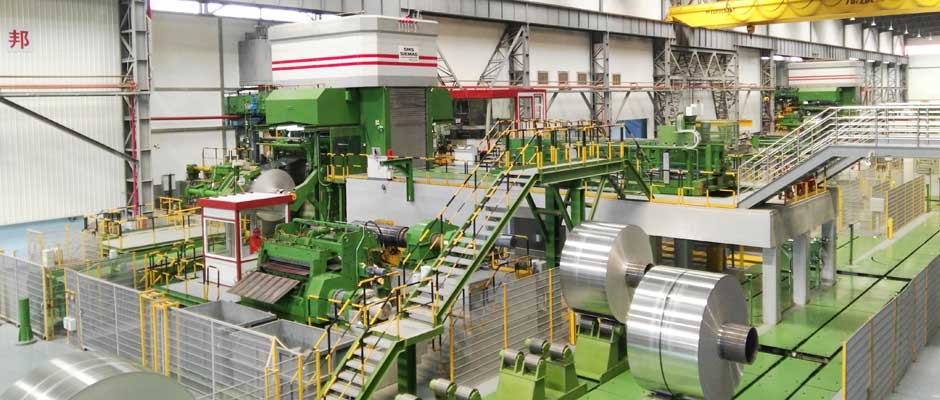
Among anodized products, light bronze is one of the categories with the highest requirements for process control precision. Unlike the high-saturation colors of organic dyeing systems, light bronze achieves a low-saturation warm copper texture through electrolytic coloring. This avoids the plasticky feel of spray-painted coatings and solves the industry pain points of poor weather resistance and easy fading of light-colored dyes, making it a preferred finishing material in high-end architectural decoration, premium signage, and high-end home appliances in recent years. Haomei Aluminum achieves stable mass production and batch consistency of light bronze anodized aluminum sheets through refined parameter control of its independent electrolytic coloring production line, providing global customers with aluminum finishing solutions that combine aesthetic appeal and long-lasting performance.
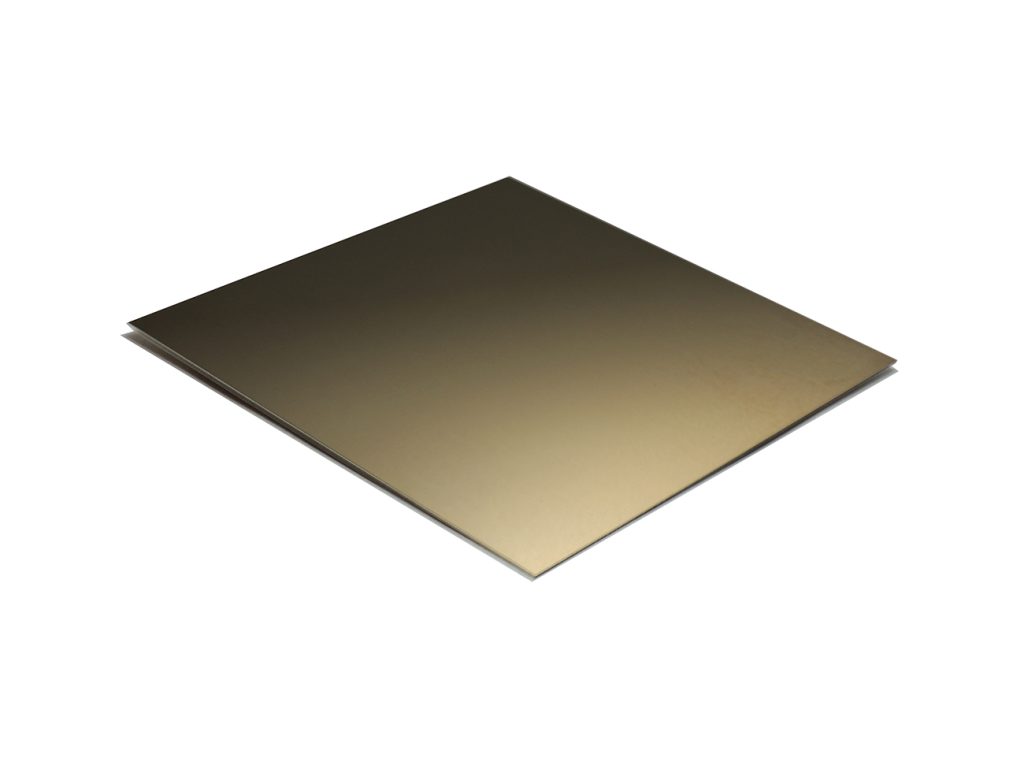
The coloring logic of light bronze differs significantly from conventional dyeing and oxidation. Based on the porous film layer generated by sulfuric acid anodizing, a tin salt electrolytic coloring process is used to uniformly deposit metallic tin particles at the bottom of the oxide film pores. This results in a soft bronze tone due to light scattering, rather than a surface coating of pigments. Haomei precisely controls the coloring bath temperature at 22±1℃ and stabilizes the coloring voltage at 8-11V. Fine-tuning of the tone depth is achieved through 1-3 minute time adjustments, resulting in a low-saturation, light warm bronze tone with an L value of 65-70, an a value of 1-3, and a b value of 8-12. This retains the original metallic texture while avoiding the heavy, oppressive feeling of deep bronze. Thanks to the coloring mechanism of metal deposition, the product’s lightfastness far exceeds that of organic dyeing systems. The color difference within the same board ΔE ≤ 0.8, and the color difference between batches ΔE ≤ 1.2, effectively solving common mass production problems in light-colored oxidation, such as color differences at the beginning and end of the color cycle and darkening at the edges.
The base materials of light bronze anodized aluminum sheet cover three major systems: 1060 pure aluminum, 5052 rust-proof aluminum, and 6061 high-strength aluminum, matching various processing requirements such as bending, stamping, and welding. Thickness specifications cover the entire range of 0.3-6.0mm, with 0.8-2.0mm being the mainstream choice for the interior decoration and signage industry, and 2.0-4.0mm suitable for outdoor curtain walls and structural components. Standard anodized aluminum sheet sizes include 1000×2000mm, 1220×2440mm, and 1500×3000mm, supporting fixed-length cutting and continuous roll supply. Anodized film thickness adopts a graded customization scheme: 8-10μm standard film layer is recommended for indoor scenarios, 15-20μm thickened film layer is selected for ordinary outdoor environments, and 20-25μm reinforced film layer can be customized for coastal high salt spray and high UV areas. The surface base can be finished with three effects: matte, 240-400 mesh fine brushed, and 220-280 mesh fine sandblasted. The fine sandblasted base blends best with the light bronze tone, making it the mainstream choice for high-end commercial projects.
Laboratory testing shows that after 1500 hours of QUV accelerated aging, the color difference change ΔE ≤ 2.5, more than twice the color retention of ordinary organic-dyed aluminum sheets. After 1500 hours of neutral salt spray testing, there was no corrosion or peeling. The film layer has a Vickers hardness of HV280-320, and its wear resistance far exceeds that of spray coating and electrophoretic finishes. The bronze anodized aluminum sheet product complies with ASTM B580 Type II anodizing standards and has passed RoHS and REACH environmental certifications, meeting the access requirements for building materials and electronic components in major global markets such as the EU, North America, and Southeast Asia. Under the medium-temperature sealing process, the sealing weight loss is ≤0.5mg/dm², resulting in a dense, stain-resistant surface. Daily cleaning requires only a neutral detergent and water; long-term use shows no white frost or film peeling.
Light bronze anodized aluminum sheets are widely used in high-end commercial space interior walls and ceilings, brand store entrances and signage, museum exhibition facilities, high-end home appliance decorative panels, bathroom hardware accessories, and other scenarios. The soft, low-saturation color complements various design styles, and its long-lasting performance significantly reduces subsequent maintenance costs. Haomei Aluminum has an independent electrolytic coloring production line, supports customized color matching based on customer samples, maintains regular specifications in stock, and offers a 7-10 day delivery cycle for bulk orders. We supports various trade terms such as FOB, CIF, and EXW, and settles in US dollars. Each batch comes with a complete color difference test report and material certificate.