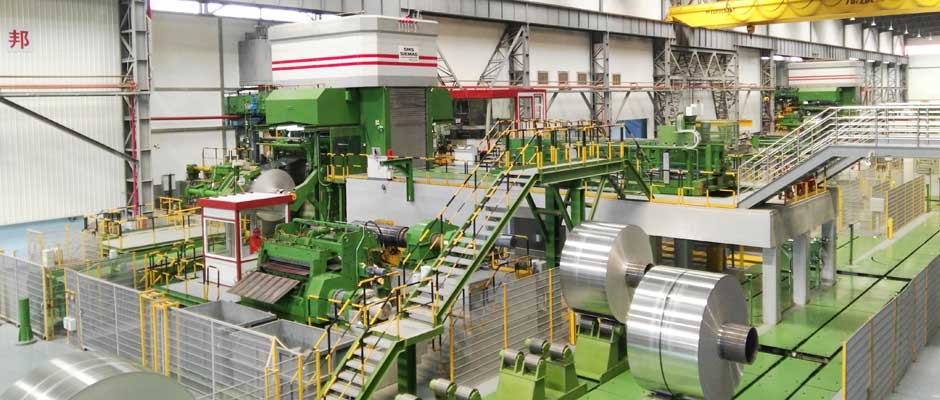
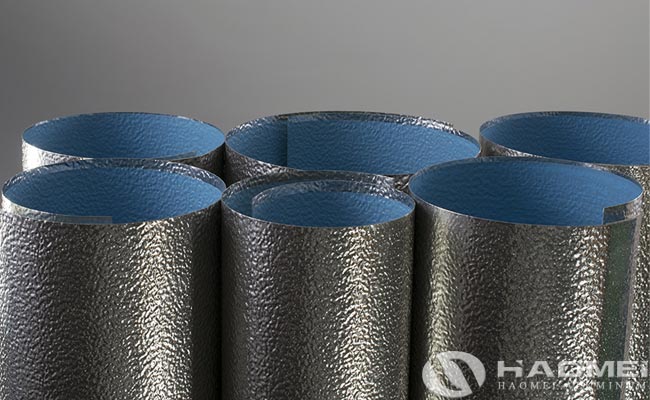
Stucco aluminium cladding for pipework are a core covering material for thermal protection of industrial pipelines and a mainstream insulation product for overseas energy, chemical, and HVAC projects. As a professional exporter of aluminum cladding sheets, we Haomei Aluminum have cultivated the global pipeline insulation supply chain for many years. Stucco aluminum cladding for pipework, with its standardized alloy ratio, stable mechanical properties, and highly adaptable embossing process, is suitable for various demanding pipeline corrosion protection and insulation needs. It is an upgraded industrial material that replaces ordinary smooth aluminum cladding coils and improves the durability of pipeline insulation systems.
Standardized alloy specifications are the core foundation for the stable quality and suitability of embossed aluminum pipeline insulation coils for overseas projects. Currently, the mainstream export models are 1060 pure aluminum series and 3003 aluminum-manganese alloy series, fully complying with international industrial standards such as ASTM B209 and ASTM C1729. The 1060 aluminum coil has an aluminum content of ≥99.6%, ensuring stable basic performance with a high-purity aluminum base material. It is typically H14/H18, with a thickness range of 0.2–1.5mm, suitable for conventional civil and general industrial pipeline projects. The 3003 aluminum-manganese anti-rust alloy is a high-end mainstream specification. Through manganese refinement of the grain and enhanced resistance, its strength surpasses that of 1060 pure aluminum, and its resistance to salt spray and acid/alkali corrosion is significantly improved. It is the preferred specification for overseas chemical and marine pipelines. Both grades can be customized in width and weight to suit different national engineering construction standards.
The mainstream stucco aluminum jacketing on the market are divided into three core categories based on surface protection technology, precisely covering the needs of different overseas pipeline construction, storage, transportation, and usage scenarios.
The first type is the stucco aluminium cladding without lamination, a basic general-purpose product. It uses an integrated roll forming process, with a standard orange peel textured surface, without any coating or paper reinforcement. The first type is lightweight, with excellent bending performance and outstanding cost-effectiveness. It is mainly suitable for indoor dry conditions, conventional HVAC, and general industrial pipe insulation, and is a common choice for overseas civil infrastructure and general industrial and mining projects.
The second type is kraft paper laminated stucco aluminium cladding, which is an upgraded moisture-proof and protective model. It has a special waterproof kraft paper laminated on the surface of the aluminum coil, which is tightly bonded and not easy to fall off. Kraft paper has excellent moisture-proof, vapor-proof, and air-permeable properties, which can effectively prevent water vapor and moisture in the air from penetrating the insulation layer, preventing the pipe insulation cotton from becoming damp and ineffective and growing mold. It is especially suitable for pipe insulation projects in humid southern regions, outdoor rainy environments, underground pipe networks, and high-humidity factories.
The third type is polysurlyn laminated stucco aluminium cladding, which is a high-end protective model. The surface is laminated with a high-transparency and tough sarin protective film. The film layer has strong adhesion, is tear-resistant, scratch-resistant, and wear-resistant. This product category perfectly avoids scratches, bumps, and stains that occur during sea transport, storage, and on-site construction. It ensures the integrity of the aluminum coil’s appearance while enhancing the sheet’s corrosion resistance and aging resistance. It is widely used in high-end overseas chemical projects, offshore platforms, and key international industrial pipeline projects. The coating can be easily removed without affecting subsequent construction and wrapping effects, fully meeting the high standards of overseas engineering acceptance requirements.
Excellent comprehensive physical and chemical properties endow stucco aluminium cladding coils with industrial-grade durability and adaptability. Compared to ordinary smooth aluminum coils, the embossing process effectively improves the rigidity and tensile strength of the sheet, avoiding the problems of deformation and dents that easily occur during the transportation and construction of thin aluminum coils. Aluminum itself is lightweight, with a density only 1/3 that of steel, significantly reducing the load on pipe supports and construction and hoisting costs. At the same time, a dense oxide protective film can form on the aluminum surface, providing rust prevention, oxidation resistance, and moisture resistance. It is impervious to complex working conditions such as high temperature, high humidity, and salt spray, and is flame-retardant and non-combustible with a low thermal conductivity, protecting the insulation layer and helping to optimize the pipeline’s thermal insulation effect.
Unique advantages in adapting to pipeline insulation scenarios make stucco aluminium cladding an essential material for industrial pipeline insulation projects worldwide.
Firstly, the embossed texture increases the contact friction between the sheet and insulation substrates such as insulation cotton, rock wool, and polyurethane, preventing aluminum sheet detachment and displacement during long-term use and ensuring the integrity of the insulation system.
Secondly, the one-piece molding process prevents cracking and peeling during bending, making it suitable for wrapping round and irregularly shaped pipes. It is easy to cut and fit, significantly shortening the overseas on-site construction cycle.
Thirdly, the product is maintenance-free and has a service life of over 15 years, eliminating the need for frequent refurbishment and repairs, effectively reducing the later-stage operation and maintenance costs of overseas projects. Its overall cost-effectiveness far exceeds that of sheet metal and ordinary plastic wrapping materials, leading to its widespread export to industrial infrastructure markets in Southeast Asia, the Middle East, Europe, and the United States.