
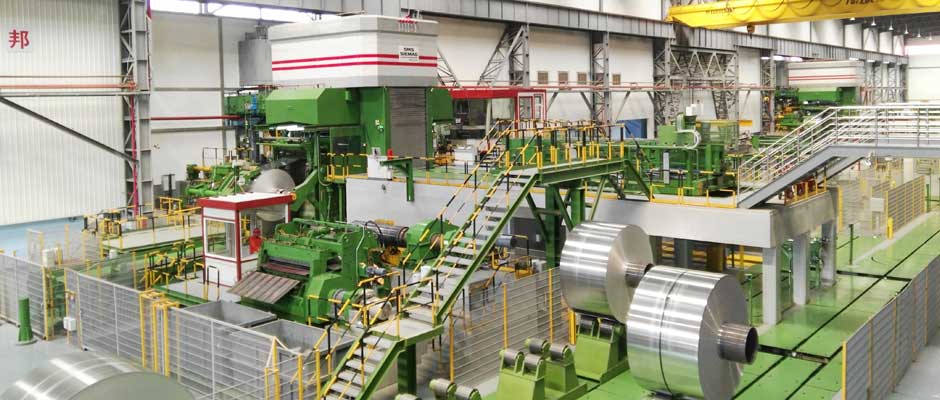
1060 and 3003 alloy orange-peel embossed aluminum sheets are the primary choice for freezer liners. Through a specialized rolling process, a uniform, orange-peel-like texture is created on the surface. This design offers an optimal balance of thermal conductivity, corrosion resistance, wear and scratch resistance, and ease of cleaning—making it the standard material for the liners of household refrigerators, commercial chest freezers, refrigerated display cases, and quick-freeze cold storage units. As a supplier of embossed aluminum sheets, our long-term sales data shows a repeat purchase rate of over 90%. This is due to the combination of the textured design and the specific alloy properties, which precisely meet the operational requirements for refrigeration equipment liners.
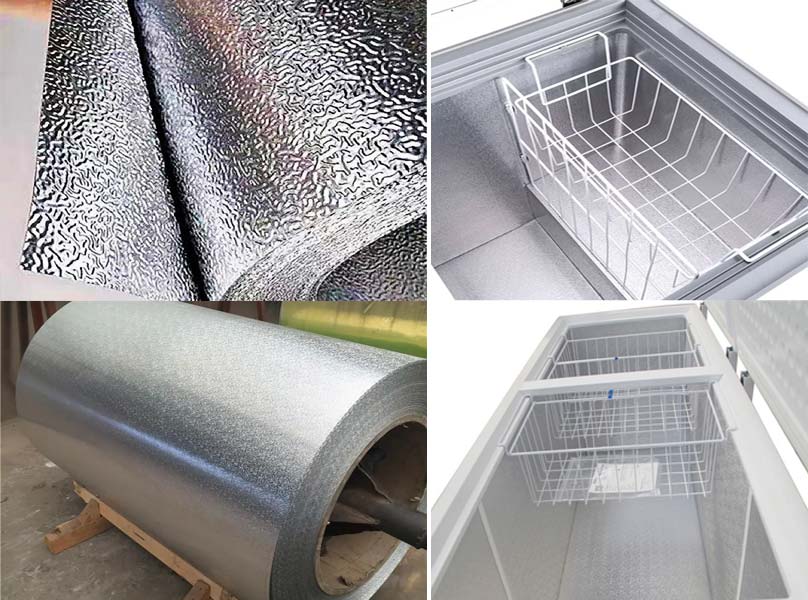
Regarding alloy selection, 1060 pure aluminum and 3003 rust-resistant aluminum provide a clear, tiered range of options to suit various operating environments.
1060 alloy aluminum has a purity of ≥99.50%, a thermal conductivity of up to 230 W/(m·K), excellent formability, and a moderate cost. It is the preferred choice for the liners of household freezers and small refrigerated cabinets, making it well-suited for standard, dry indoor refrigeration environments.
The 3003 alloy is enhanced with 1.0%–1.5% manganese, which improves its rust resistance by over 40% and strengthens its durability against humidity and mild corrosion. With a thermal conductivity of approximately 193 W/(m·K), it is widely used for commercial upright freezers, fresh-produce display cases, and refrigeration equipment in high-humidity coastal regions; it remains resistant to oxidation (whitening) and pitting even after long-term use.
Both alloys are supplied in the H14 (half-hard) temper by default, offering an optimal balance between structural rigidity and deep-draw formability. Alternatively, they can be supplied in the O (soft/annealed) temper to suit specific customer forming processes.
Embossed aluminum sheets for freezer have established a mature, standardized system, ensuring compatibility with industry-standard forming molds. Available in thicknesses ranging from 0.2 mm to 1.2 mm, the most frequently used specifications—0.3 mm, 0.4 mm, and 0.5 mm—are tailored for compact mini-freezers, residential chest freezers, and large-capacity commercial freezers, respectively. The embossing depth is strictly controlled between 0.08 mm and 0.15 mm, with a texture uniformity deviation of ≤0.02 mm, ensuring a consistent appearance across the entire sheet without variations in depth or missed impressions. Coils can be slit to widths between 100 mm and 1500 mm to integrate directly into customers’ continuous stamping production lines; alternatively, the material can be supplied as cut-to-size flat sheets, customized to fit specific liner layout requirements. Precision is maintained with a thickness tolerance of ±0.03 mm and a slitting width deviation of ≤±0.2 mm, ensuring dimensional consistency during high-volume production.
The “orange-peel” texture serves a functional purpose, offering several practical advantages in refrigeration applications.
Primarily, it enhances heat-transfer efficiency: the textured surface increases the contact area between the freezer liner and the internal air by approximately 15%. This facilitates more thorough and uniform heat exchange, leading to faster cooling—tests show a reduction of about 8% in the time required to cool an empty unit—which indirectly lowers the energy consumption of the equipment during operation.
Furthermore, these surfaces offer excellent scratch and wear resistance, with the texture effectively masking minor abrasions incurred during handling, assembly, or daily use. This ensures the material retains its pristine appearance over the long term—offering a 30% improvement in visual durability compared to smooth-surfaced sheets.
Additionally, the surface is hydrophobic and easy to clean; condensation does not spread across the textured surface but instead forms droplets that slide off quickly. This minimizes water residue, simplifies maintenance, and meets hygiene standards for materials in contact with food.
Based on our extensive experience supplying the refrigeration industry, the uniformity of the texture is the critical benchmark for the quality of embossed aluminum freezer sheets. Some smaller manufacturers use embossing rollers with insufficient precision, resulting in inconsistent texture depth or missed patterns. During the deep-drawing process used to form the inner liner, this can lead to localized stress concentrations, causing cracking or uneven spring-back—issues that can reduce production yields by more than 10%. Haomei embossed aluminum sheets are produced using high-precision engraved embossing rollers, ensuring that texture depth variation within a single coil is kept under 0.02mm. We supply major overseas freezer manufacturers, consistently achieving a first-pass yield of over 98.5% during the forming process.
Haomei Aluminum offers a full range of embossed aluminum sheets for freezers, available in 1060 and 3003 alloys. We provide customizable options for thickness, width, and pattern depth. With substantial stock readily available, standard orders can be dispatched for shipment within seven days. Our products comply with safety standards for food-contact materials and are accompanied by comprehensive material test reports and export customs documentation, providing a stable, reliable, one-stop supply of embossed aluminum sheets for refrigeration equipment manufacturers worldwide.