
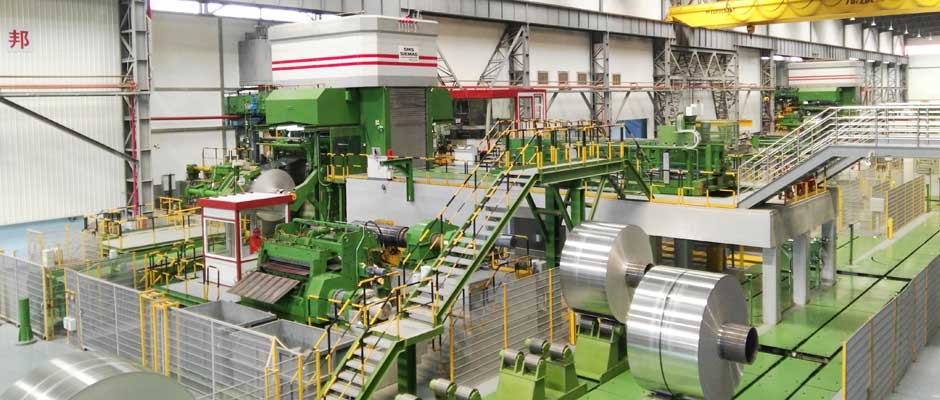
Color coated aluminum coil for car license plates are industrial materials made from aluminum alloy as the base material, treated with a surface coating for coloring. They are primarily used as the base material in vehicle license plate production, and their properties and manufacturing process together ensure the durability and functionality of the license plates.
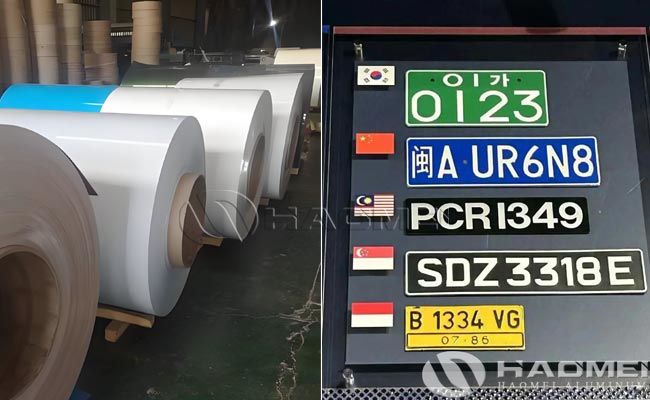
Material selection of coated aluminum coil for car license plate:
Vehicle license plates production typically uses 1xxx and 3xxx series color coated aluminum coils. The 1xxx series, such as 1060, is industrial pure aluminum with an aluminum content of over 99.6%, offering good corrosion resistance and processing performance at a lower cost. The 3xxx series, such as 3003, is an aluminum-manganese alloy, with higher strength than pure aluminum, good corrosion resistance, and excellent formability, meeting the stamping and bending requirements of vehicle license plate production. Common tempers for color coated aluminum coils include H14, H18, and H24.
Specifications of color coated aluminum coil for car license plates:
The thickness of color coated aluminum coils is generally between 0.05mm and 2mm, and the width ranges from 100mm to 1220mm. The color coated aluminum coils used for making car license plates are usually selected and processed according to the standard dimensions of license plates, with a thickness mostly between 0.5mm and 1.5mm.
Coating of coated aluminum coil for car license plates:
The coating of color coated aluminum coils used for car license plates is generally polyester (PE) or fluorocarbon (PVDF) coating. The coating thickness is typically between 15 micrometers and 28 micrometers. Polyester coatings offer good decorative properties and weather resistance, with vibrant colors, meeting the requirements for car license plates in general environments, and are relatively inexpensive. Fluorocarbon coatings offer stronger weather resistance and corrosion resistance, maintaining color and performance stability for extended periods in harsh environments, with a service life of approximately 30 years, but are more expensive.
Characteristics of color coated aluminum coil for car license plates:
Lightweight:
Aluminum has a density of 2.71 g/cm³, only one-third that of steel. This allows color-coated aluminum coils to maintain a certain strength while significantly reducing the weight of license plates, contributing to a reduction in overall vehicle weight and improved fuel economy.
Corrosion resistance:
Color coated aluminum coils have self-rust-preventing capabilities. The oxide layer formed on its surface effectively prevents metal oxidation and corrosion, and it has good acid and alkali resistance. This characteristic allows license plates to be used for a long time in various harsh environments without easily being damaged.
Diverse and aesthetically pleasing surface treatments:
The surface of color coated aluminum coils can undergo various treatments, such as anodizing, electrophoresis, chemical treatment, polishing, and painting, to meet the needs of different customers. In license plate production, painting is commonly used to make the license plate surface bright in color and high in gloss, enhancing the overall aesthetics.
Good plasticity and easy processing:
Color-coated aluminum coils have good plasticity, allowing for easy stamping, cutting, and bending operations. This characteristic makes the license plate manufacturing process more flexible and diverse, capable of meeting the needs of different shapes and sizes.
Environmentally friendly and recyclable:
Color coated aluminum coils are an environmentally friendly material that is 100% recyclable. This aligns with current global requirements for environmental protection and sustainable development, helping to reduce resource waste and environmental pollution.