
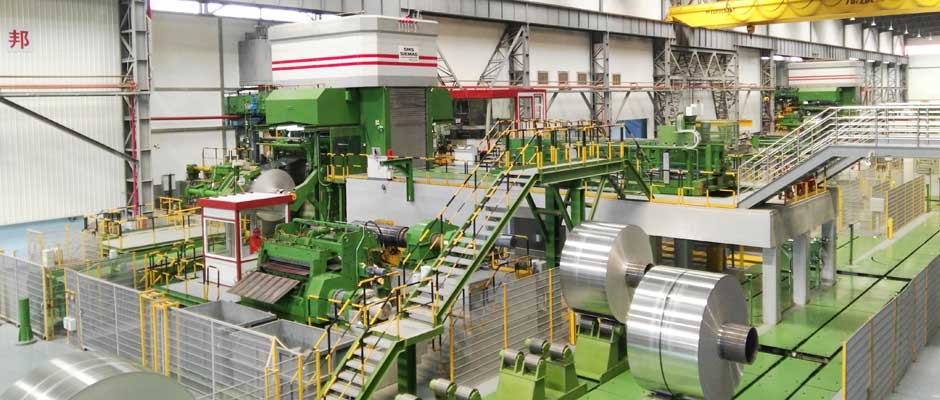
Stair treads in public buildings, industrial plants, municipal walkways, and ship cabins are high-risk, high-traffic areas. Anti-slip failure, corrosion, deformation, and cumbersome maintenance have long been core pain points for engineering projects. Traditional carbon steel treads are prone to rust and paint peeling, and condensation and slipping in low temperatures. Composite panels have short wear lifespans and are easily deformed under heavy loads. Aluminum checker plates, with their directional anti-slip structure, lightweight high-strength characteristics, and long-lasting weather resistance, have become the upgraded choice for various stair treads, fully meeting engineering-grade usage requirements from safety performance and construction compatibility to long-term maintenance.
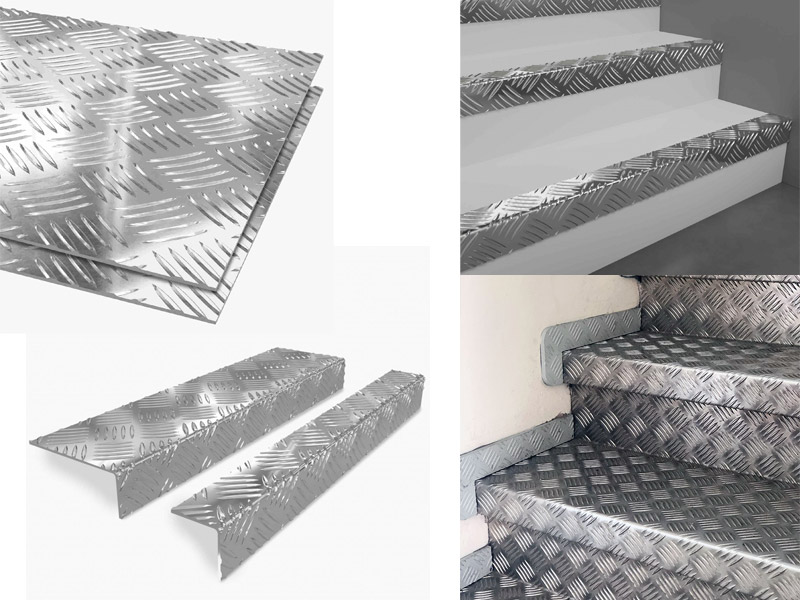
The anti-slip logic of stair treads differs from that of flat platforms. Foot pressure is concentrated on the leading edge of the tread, and the force direction is fixed, requiring higher standards for localized wear resistance and anti-slip stability. The mainstream five bar pattern uses a circular arc rib structure arranged at a 45° angle to the length of the tread, with the rib height precisely controlled between 0.3-1.0mm. The dry static friction coefficient reaches over 0.62, and remains above 0.42 in wet conditions, meeting the general requirements for anti-slip safety in building floors. The lentil-shaped pattern, with its continuous arc-shaped guide design, can quickly drain rainwater, dust, and oil, preventing liquid accumulation on the tread surface and the formation of a slippery layer, making it more suitable for outdoor staircases. For the high-wear leading edge, customized thickened ribs and anti-slip teeth can be added to enhance the wear resistance of high-frequency trowel areas and extend the overall service life of the tread.
Different alloy selections are made for different usage scenarios, balancing performance and cost.
For light-load pedestrian staircases in indoor commercial buildings and office buildings, 1060-H24 or 3003-H14 aluminum checker plates are commonly used, with a thickness of 1.5-2.5mm. These plates offer high flatness and good formability, are suitable for various decorative surface treatments, and weigh only one-third of steel plates of the same specifications, eliminating the need for additional reinforcement of the staircase base.
For medium-to-heavy-load staircases in industrial plants and outdoor municipal passageways, 3003-H24 rust-resistant aluminum checker plates are preferred, with a thickness of 2.0-3.0mm. The manganese content provides excellent rust resistance and impact resistance, making them suitable for outdoor environments with alternating wet and dry conditions and industrial dust.
For highly corrosive environments such as coastal walkways and ship cabins, 5052-H32 magnesium-aluminum alloy aluminum checker plates are used, with a thickness of 2.5-4.0mm. These aluminum checker plates have a tensile strength exceeding 230MPa, excellent salt spray resistance, and can withstand long-term exposure to marine climates and high-humidity environments.
In terms of engineering adaptability, aluminum checker plates support CNC cutting to precisely match standard step widths of 200-300mm and common lengths of 600-1200mm, with dimensional tolerances controlled within ±0.2mm. Pre-fabricated installation holes, side folds, and rounded corners eliminate on-site cutting and grinding processes, significantly improving installation efficiency. The folded edge treatment increases the rigidity of the step structure by over 30%, resulting in no noticeable deformation or abnormal noise when stepped on, meeting the requirements of public buildings for quietness and comfort.
Compared to traditional step materials, aluminum stair treads do not require regular rust removal and painting. Under normal working conditions, their service life can reach over 15 years. After disposal, they can be fully recycled and reused, offering significant advantages in total lifecycle cost. As a professional aluminum checker plate manufacturer, we can customize patterns, alloys, and sizes according to project requirements. All products undergo flatness, anti-slip performance, and dimensional accuracy testing, meeting international engineering standards and adaptable to various building and industrial staircase projects worldwide.