In industrial workshop operating platforms, ship open decks, municipal walkways, and heavy equipment maintenance platforms, anti-slip safety is the core bottom line of operating condition design. Traditional carbon steel checker plates and fiberglass gratings are prone to rust and paint peeling, wear down of the anti-slip texture, and heavy self-weight loads after long-term service, not only increasing later maintenance costs but also creating safety hazards such as personnel slipping and equipment displacement. Aluminum checker plates, with their stable mechanical anti-slip structure, lightweight strength, and long-lasting weather resistance, are becoming the mainstream upgrade material for various anti-slip platforms, providing reliable long-lasting anti-slip solutions for global industrial and infrastructure scenarios.
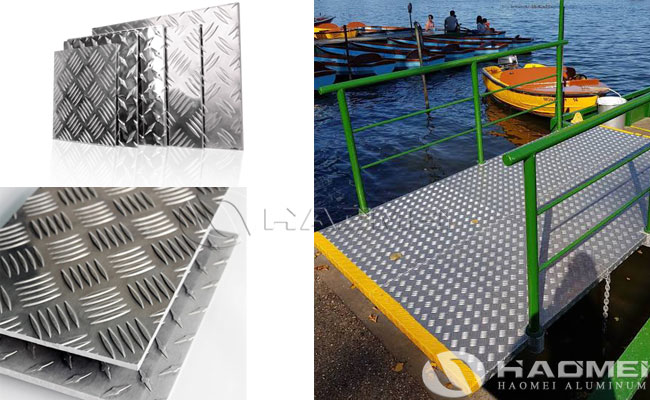
The core of anti-slip performance stems from the mechanical design of the pattern structure, rather than simply the surface texture treatment. The most commonly used five bar pattern on industrial platforms employs five sets of parallel, evenly spaced circular arc ribs at 45° intervals. The rib height is precisely controlled within the 0.3-1.2mm range, creating a multi-directional mechanical interlocking effect on the contact surface. The dry static friction coefficient can reach over 0.65, and it maintains a friction coefficient of over 0.45 in wet environments, meeting the requirements of the ISO 13036 industrial anti-slip flooring standard. For processing workshop platforms with heavy oil stains, the lentil-shaped pattern, with its larger contact area and oil-guiding groove design, can quickly drain surface liquids and debris, preventing the formation of a continuous slippery layer. The diamond pattern is suitable for public platforms with multi-directional traffic, offering more balanced anti-slip performance at all angles, without restrictions on traffic direction.
For anti-slip platforms with different load and corrosion levels, matching the corresponding alloy system can achieve an optimal balance between performance and cost.
For indoor lightweight pedestrian platforms and equipment operating surfaces, 1060 series pure aluminum checkered plates are commonly used. They are lightweight, have good formability, and a standard thickness of 1.5-3.0mm is sufficient to meet daily pedestrian load requirements, making procurement costs more controllable.
For outdoor open-air platforms, refrigerated truck flooring, water treatment plant walkways, and other damp and corrosive environments, 3003 rust-resistant aluminum alloy checkered plates are more suitable. The manganese element provides long-lasting rust resistance, eliminating the need for additional anti-corrosion coatings and preventing rust flakes and pollution over long-term use.
For high-load-bearing and highly corrosive conditions such as ship decks, port operation platforms, and heavy machinery maintenance access roads, 5052 and 5754 series magnesium-aluminum alloy checkered plates are preferred. These aluminum checker plates have a tensile strength exceeding 200MPa, excellent impact resistance and salt spray resistance, and are suitable for heavy-duty equipment access and marine atmospheric environments.
Compared to traditional anti-slip materials, the engineering value of aluminum checkered plates extends throughout the entire project lifecycle. Its density is only one-third that of carbon steel, significantly reducing the load on the platform structure and decreasing the amount of steel used in the supporting structure. It is particularly suitable for platform renovation projects of existing buildings, eliminating the need for additional foundation reinforcement. The plates can be cut to specific lengths to precisely fit complex layouts such as irregular corners and equipment openings on the platform. On-site installation requires no welding; bolt splicing is sufficient, significantly improving construction efficiency. Its long-lasting corrosion resistance eliminates the need for regular rust removal and painting maintenance. Under normal operating conditions, its service life can reach over 15 years, and scrap plates are fully recyclable, making its overall cost far lower than carbon steel and plastic grating.
As a professional exporter of aluminum checkered plates, we can provide customized material selection and size solutions based on platform conditions. All aluminum checker plates undergo triple testing before leaving the factory for flatness, rib height consistency, and friction coefficient to ensure uniform and stable anti-slip performance across the entire platform. The products meet international industrial safety and environmental certifications and are suitable for the construction needs of anti-slip platforms in various industrial plants, municipal projects, and ships/vehicles worldwide.