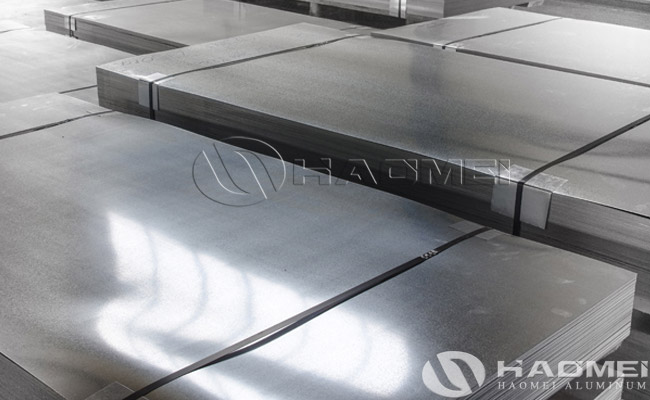
7075-T6 aluminum represents the peak aging state of an aluminum-zinc-magnesium-copper series ultra-high strength aluminum alloy, and is recognized globally as a “lightweight, high-strength benchmark material.” As a core category of Haomei Aluminum’s high-end export product line, 7075-T6 aluminum achieves the strength ceiling in the aluminum alloy field through a standard heat treatment process of solution treatment + artificial aging—typical tensile strength ≥ 505 MPa, yield strength ≥ 435 MPa, and specific strength far exceeding that of ordinary low-carbon steel, while retaining the lightweight advantages of aluminum. It is not a general-purpose industrial aluminum material, but a high-end functional material precisely matching the needs of “extreme weight reduction + high load-bearing capacity and fatigue resistance,” and its application scenarios always revolve around the core value of “strength for weight.”
Aerospace is the origin and core application field of 7075-T6 aluminum alloy, and also the highest standard scenario for its performance verification. As early as the mid-20th century, this alloy became a standard material in the aerospace industry due to its excellent specific strength and fatigue resistance. In civil airliners and general aviation aircraft, 7075-T6 aluminum is widely used in core load-bearing components such as wing skin, fuselage load-bearing frames, landing gear support structures, and avionics load-bearing bases. It reduces weight by more than 60% compared to steel components under the same load-bearing capacity, directly improving the aircraft’s fuel efficiency and payload. Its excellent resistance to cyclic fatigue can adapt to the repeatedly changing air pressure and mechanical loads during flight. All aerospace-grade 7075-T6 aluminum plates supplied by Haomei have undergone ultrasonic flaw detection, showing no internal delamination or inclusion defects, and meet ASTM B209 aerospace-grade quality requirements.
High-end molds and precision tooling are the largest industrial applications for aluminum 7075-T6. Compared to 6061-T6 mold plates, 7075-T6 aluminum boasts a Brinell hardness exceeding 150 HB, offering 40% improved wear resistance. Furthermore, it exhibits uniform internal stress distribution at its peak aging state, with dimensional deformation controlled within 0.03 mm/m after finishing, demonstrating dimensional stability far surpassing ordinary aluminum alloys. It is widely used in large and medium-sized plastic mold frames, automotive body panel blow molding molds, precision testing fixtures, and high-load-bearing tooling fixtures for automated equipment. Particularly for large molds requiring weight, precision, and lifespan, replacing steel with aluminum 7075-T6 significantly reduces mold assembly and disassembly loads, while extending mold lifespan by over 30%. The finished surface boasts a high degree of smoothness, eliminating the need for additional heat treatment.
High-end transportation and extreme sports equipment represent typical applications for aluminum 7075-T6’s expansion into the high-end civilian market. In the fields of professional racing and high-performance modified vehicles, 7075-T6 aluminum is used to manufacture structural components such as suspension control arms, chassis reinforcements, and wheel hub cores. While meeting track-level impact load requirements, it significantly reduces unsprung mass, improving vehicle handling performance. In the high-end outdoor and sports sector, it is a core raw material for professional trekking poles, extreme sports bicycle frames, high-end bicycle load-bearing components, and rock climbing protective equipment. Its lightweight and high-strength characteristics minimize equipment weight while ensuring safety. Furthermore, this material is frequently used in high-strength load-bearing components in the shipbuilding industry and in the pressure-resistant structures of deep-sea equipment.
It is important to clarify that aluminum 7075-T6 has clear performance boundaries, which is crucial for professional selection. This alloy has weaker resistance to intergranular corrosion than 5000 series rust-resistant aluminum, and is not recommended for direct use in highly corrosive marine environments. It also has poor weldability, making it primarily suitable for integral machining applications. Haomei Aluminum proactively provides selection and adaptation advice to customers during the supply chain to avoid performance mismatches. Our 7075-T6 aluminum sheet metal covers a full thickness range from 1.5mm to 120mm, supports fixed-length cutting and customized pre-treatment, and each batch comes with complete mechanical property and flaw detection reports, meeting the stringent supply requirements of the global aerospace, mold, and high-end manufacturing industries.