In shipbuilding, offshore platforms, and high-pressure vessels, material selection directly determines equipment lifespan and safety. As a typical representative of aluminum-magnesium alloys, 5086-H116 aluminum plate, with its unique composition design and heat treatment process, has become a core solution for high corrosion resistance and high strength applications.
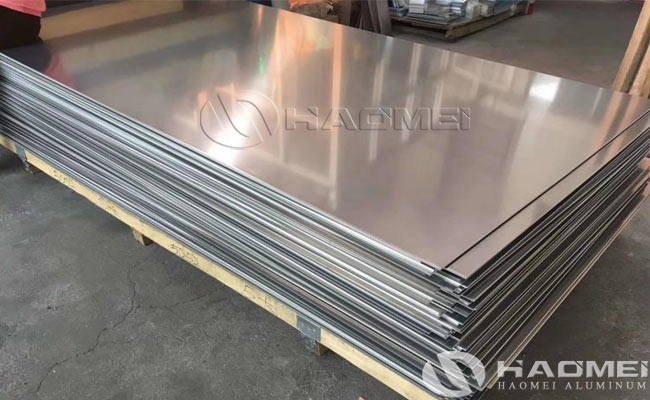
The chemical composition of 5086-H116 strictly adheres to the standard, with core components of 3.5%-4.5% magnesium (Mg) and 0.20%-0.7% manganese (Mn), supplemented with trace amounts of titanium (Ti≤0.15%) and chromium (Cr 0.05%-0.25%).
The magnesium element forms a dense Mg₂Al₃ oxide film within the aluminum matrix, significantly enhancing the material’s resistance to pitting corrosion in seawater environments. Experimental data shows that in a 3.5% NaCl salt spray environment, the corrosion rate of 5086-H116 is 42% lower than that of 5052 aluminum plate. This characteristic makes 5086 aluminum plate the preferred material for ship hulls, decks, and other components that are submerged in water for extended periods.
The addition of manganese strengthens the material through solid solution treatment and second-phase precipitation, increasing the yield strength to ≥95MPa and stabilizing the tensile strength at ≥240MPa while maintaining material ductility. This balance between strength and toughness allows 5086-H116 to maintain structural integrity when subjected to wave impacts and equipment vibrations, while also enabling the formation of complex curved surfaces through cold working.
The H116 temper represents the process path of natural aging after solution treatment. Compared to artificially aged states such as H321, H116, by controlling the natural aging time, allows for the uniform precipitation of second-phase particles such as Mg₂Si, forming a fine-sized (diameter ≤50nm) and densely distributed strengthening phase. This microstructure not only enhances material strength but also elevates stress corrosion cracking (SCC) resistance to industry-leading levels by blocking corrosion pathways. In pressure vessel applications, 5086 aluminum plates in the H116 temper can withstand internal pressures up to 15 MPa and maintain dimensional stability within a temperature range of -40°C to 80°C. Field test data from a marine platform project shows that gas storage tanks manufactured using 5086 H116 aluminum plates showed no cracks or leaks during a 5-year service life, while 5052 aluminum plates under the same conditions required repairs every 2 years.
Application scenarios of 5086 h116 aluminum plate covering all areas from ocean to land:
Shipbuilding:
The lightweight characteristics of 5086-H116 (density 2.66 g/cm³) can reduce ship weight by 15%-20%, significantly improving speed and fuel economy. Its excellent weldability (weld coefficient ≥ 0.85) supports MIG/TIG welding processes, enabling efficient connections in hull structures. After a 100,000-ton cargo ship project replaced traditional steel with 5086-H116, the annual operating cost per ship decreased by approximately 3.2 million yuan.
Pressure vessels:
In the manufacture of liquefied natural gas (LNG) transport tanks, the low-temperature toughness (impact energy ≥34J at -196℃) and corrosion resistance of H116 prevent thinning of the tank’s inner wall due to media corrosion, extending the equipment’s service life to over 25 years.
Special equipment:
In high-strength applications such as missile casings and armored vehicle underplates, 5086-H116, through optimized rolling processes (e.g., hot rolling final rolling temperature controlled at 480-520℃), achieves grain refinement (ASTM grain size ≥8), further enhancing the material’s impact resistance.
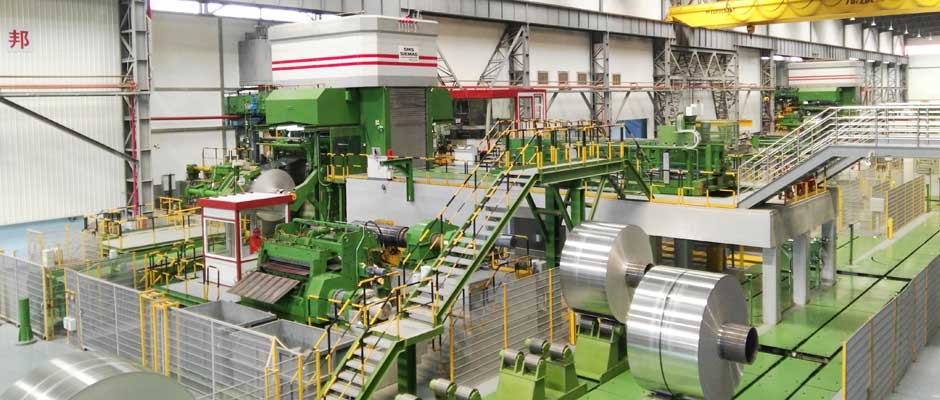
The production of 5086-H116 aluminum sheets requires strict control over three key processes:
– Melting and purification:
A three-stage filtration system (pore size ≤20μm) is used to control the hydrogen content below 0.12mL/100gAl, reducing porosity defects;
– Rolling parameters:
Hot rolling final rolling temperature is controlled at 480-520℃, and total cold rolling deformation is ≤85%, avoiding cracking caused by work hardening;
– Solution treatment:
After holding at 500±5℃ for 2 hours, water quenching ensures full dissolution of Mg₂Si, providing a uniform precipitation basis for natural aging.
Through composition optimization, process innovation, and scenario adaptation, 5086 H116 aluminum plates have built a three-dimensional technological advantage of “corrosion resistance, strength, and lightweight.” For customers seeking optimal equipment lifecycle costs, choosing 5086 H116 aluminum sheet is not only a material upgrade but also a long-term investment in safety and efficiency. As a technician at an aluminum sheet manufacturing plant, I firmly believe that this material can meet our customers’ needs in terms of structural strength, durability, and processing flexibility. In future production, we will continue to optimize our manufacturing processes and improve product quality to better serve our customers.