H24 aluminium sheets are wrought aluminum alloy products that have been strain-hardened and partially annealed. Manufactured in strict accordance with international standards such as ASTM B209 and EN 485, these aluminum sheets utilize precisely controlled cold-rolling deformation and low-temperature annealing to achieve a semi-hard strength level while minimizing residual stress and maximizing forming stability. As a professional aluminum sheet supplier, Haomei long-term supply data indicates that h14 temper is highly suitable for precision sheet metal fabrication, architectural cladding, and automotive components. In mass production, it offers superior dimensional consistency and higher processing yields compared to aluminum sheets that have been strain-hardened alone.
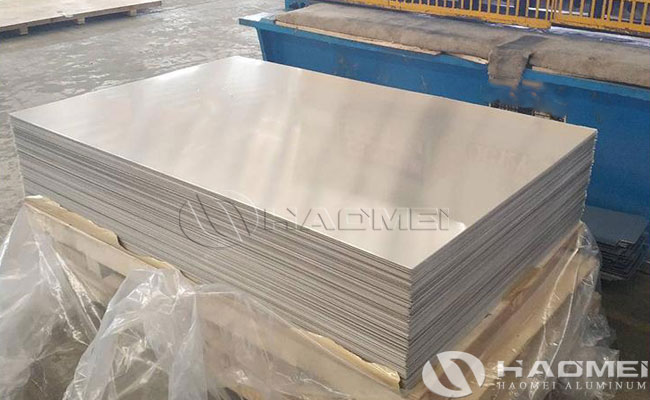
Defined by its standard production process, the H24 temper is characterized by a dual-stage treatment: “hardening + stabilization.” During manufacturing, the material undergoes approximately 50% cold-rolling deformation to achieve a semi-hard state, followed by a short-duration, low-temperature partial annealing process. This step eliminates a portion of the internal stress generated during rolling, resulting in a material that matches the strength of the H14 temper while offering improved plasticity and dimensional stability. According to the ASTM B209 standard, both H24 and H14 tempers fall under the “1/2 hard” category, sharing the same minimum mechanical property requirements. However, H24 undergoes a stabilization process, which limits hardness variation within a single coil to within ±3 HB. This results in greater consistency across batches, meeting the stringent uniformity requirements of automated, high-volume production lines.
For mainstream alloys, H24 temper aluminum offers options.
1060-H24 pure aluminum sheet features a tensile strength of 105–145 MPa, a yield strength (0.2% offset) of ≥75 MPa, an elongation of 8%–12%, and a Brinell hardness of approximately 35–40 HB. With excellent electrical and thermal conductivity, it is well-suited for heat sinks, decorative signage, and shallow-stamped hardware components.
3003-H24 aluminum sheet—the most widely used rust-resistant aluminum alloy—offers a tensile strength of 145–195 MPa, a yield strength (0.2% offset) of ≥115 MPa, an elongation of 6%–10%, and a Brinell hardness of approximately 40–45 HB. It allows for a 90° cold-bend radius of 0.5–1.5 times the sheet thickness, balancing corrosion resistance with formability; it is the standard material for architectural cladding, ventilation ducts, and electrical enclosures.
5052-H24 aluminum sheet, a medium-strength rust-resistant alloy, provides a tensile strength of 200–230 MPa, a yield strength (0.2% offset) of 170–200 MPa, and an elongation of 9%–13%. Its strength is comparable to that of common low-carbon steel, and it exhibits exceptional resistance to salt-spray corrosion, making it ideal for outdoor equipment housings, automotive sheet metal, and marine interior components.
In terms of dimensional precision, standard sheets with thicknesses between 0.5 mm and 3.0 mm are manufactured with a tolerance of ±0.04 mm and a surface flatness of ≤0.3 mm/m, allowing them to be fed directly into CNC bending and stamping production lines.
The forming stability resulting from low residual stress is the core competitive advantage of H24 aluminium sheets. Compared to the H14 (strain-hardened) temper aluminum sheet, H24 aluminum sheets exhibit approximately 15% less springback during bending. This ensures superior dimensional accuracy during multi-stage, continuous bending processes and minimizes deformation caused by stress relief—whether during welding or over long periods of storage. In one instance, an overseas manufacturer of precision electrical enclosures—who previously used H14-temper aluminum sheets for side panels—faced significant fluctuations in bending angles and inconsistent assembly gaps, resulting in a first-pass yield of only about 92%. After switching to 3003-H24 aluminum sheets, the bending angle deviation was stabilized within ±0.5°, and the first-pass assembly yield rose to 98%. This eliminated the need for manual corrective shaping and increased production line capacity by approximately 8%.
H24 aluminium sheets are highly versatile; beyond precision sheet metal fabrication and architectural cladding, they are widely used for deep-drawn kitchenware, automotive interior components, liners for refrigeration equipment, and various stamped hardware parts. Haomei Aluminum offers H24 aluminum sheets across all major alloy series—including the 1xxx, 3xxx, and 5xxx series—in thicknesses ranging from 0.2 mm to 6.0 mm. We provide flexible delivery options, including coils, cut-to-length sheets, and slit strips. With substantial ready-to-ship inventory, standard orders can be dispatched and cleared for export within seven days. Every batch undergoes rigorous hardness and dimensional testing and is supplied with full material certification and export customs documentation.