
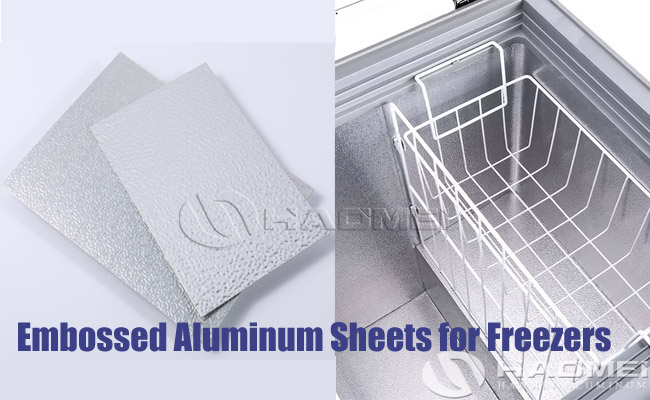
Embossed aluminum sheets—featuring a “stucco” (or orange peel) texture—are specialized materials used for the interior liners and partitions of commercial upright display cabinets, chest freezers, and low-temperature storage units in professional kitchens. Haomei Aluminum is a long-term supplier to refrigeration equipment manufacturers, providing embossed aluminum sheet for freezer engineered to meet industry-standard processing requirements, such as high-volume bending, vacuum forming, and assembly. These embossed aluminum sheets maintain consistent performance even in low-temperature environments characterized by high humidity and frequent temperature fluctuations.
Embossed aluminum sheet for freezer are manufactured using 1060 pure aluminum or 3003 aluminum-manganese alloy, typically in H14 or H24 tempers. The 1060 alloy (≥99.6% purity) offers a thermal conductivity of 237 W/m·K, ensuring uniform heat transfer—an ideal choice for evaporator backing plates and direct-cooling freezer liners. The 3003 alloy, containing 1.0–1.5% manganese, provides superior resistance to moisture and corrosion (withstanding up to 500 hours in salt spray tests), making it well-suited for open-style commercial display cases and high-humidity kitchen refrigeration equipment. Standard sheet thicknesses range from 0.25 mm to 1.2 mm, with a maximum width of 1500 mm. The embossing process increases the overall thickness by 0.1–0.25 mm, which enhances the rigidity of the sheet and reduces the risk of bulging or deformation after assembly.
The “orange-peel” texture, created through roller embossing, forms a dense, continuous pattern of raised and recessed features. This increases the surface area available for heat exchange, improving thermal efficiency by 15–20% compared to smooth aluminum sheets of the same thickness. The texture also helps mask minor surface imperfections, such as light scratches or fingerprints, thereby reducing the frequency of cleaning required by the end user. Surface treatment options include bare (mill-finish), anodized (with an oxide layer thickness of ≥15 μm), and food-grade PE pre-coated finishes—the latter meeting hygiene standards for food-contact applications, making it ideal for refrigerated display cases used for fresh produce, beverages, and frozen foods in supermarkets and retail stores. Strict dimensional tolerances—±0.02 mm for thickness and ≤1 mm for width—ensure uniform seams after large-scale cutting and bending, minimizing the need for manual adjustments during equipment assembly.
In our experience working with refrigeration equipment manufacturers, material selection is typically based on the specific requirements of the interior structure. Thinner gauges (0.25–0.45 mm) are suitable for vacuum-formed liners; 0.5–0.8 mm embossed aluminum sheets are used for bent side panels and shelving partitions; and 0.8–1.2 mm embossed aluminum sheets are employed for load-bearing door liners and reinforcement panels. The material is compatible with standard fabrication processes, including TIG welding, hemming, and punching, with high resistance to cracking or loss of texture during forming. For instance, we supplied 3003-H14 orange-peel embossed aluminum sheets to a Southeast Asian refrigeration brand for use in beverage display coolers for a convenience store chain. Three years post-delivery, there have been no reports of peeling or pitting, leading the manufacturer to establish a long-term, recurring supply partnership.
When sourcing embossed aluminum sheet for freezer and refrigeration units, key considerations include texture consistency, surface cleanliness, and the control of color variation between batches. At Haomei Aluminum, we utilize fixed roller sets to ensure uniform texture depth. Each shipment is accompanied by a material certificate and performance test report. We offer custom-cut sizing based on client blueprints, and our products are packaged on waterproof-wrapped wooden pallets to minimize the risk of moisture damage during ocean transit. We support both bulk supply and small-scale trial orders. Standard samples are dispatched within 3–5 days, and lead times for mass production remain stable and predictable.