As professionals in the aluminum processing field at Haomei Aluminum’s Production Technology Department with over a decade of experience, we firmly believe that the core value of al-mg-mn alloy sheets lies in overcoming the inherent contradiction of single-metal materials being “weak if light, heavy if strong” through precise proportions and advanced processing of aluminum, magnesium, and manganese. The al-mg-mn sheet, widely used in landmark buildings and high-end industrial applications globally, is not simply a combination of metals, but a performance-optimized solution refined through rigorous testing. Every characteristic reflects meticulous control over the production process and a deep adaptation to customer needs.
Composition Code: The Cornerstone of Ternary Synergy
Alu-mg-mn alloy sheets use high-purity aluminum as the base material, supplemented with magnesium and manganese to form a ternary alloy system. The mainstream grade is AA3004 aluminum sheet. Its composition ratio has been verified through industrial practice, forming a stable performance closed loop.
Aluminum, as the matrix element, accounts for over 95%, not only endowing the material with a lightweight characteristic of 2.73 g/cm³ (only 1/3 that of steel), but also constructing the first line of defense against corrosion through a naturally formed 2-5 nanometer dense Al₂O₃ oxide film on its surface. This characteristic is crucial for projects exported to Southeast Asia, the Middle East, and other high-humidity, high-salt-spray regions, and is the core reason why we insist on using high-purity aluminum ingots of over 99.7% during raw material selection—for every 0.1% reduction in impurity content, the density of the oxide film can increase by 8%, directly extending the material’s service life.
Magnesium, as the strength-enhancing element, is added in a controlled range of 1.0%-1.5%. Through solid solution strengthening, it refines the alloy grains, causing the material’s tensile strength to jump to over 265 MPa and its yield strength to reach 170 MPa, which is 2.5 times that of ordinary pure aluminum plates. In Haomei’s production practice, we have found that precise control of magnesium content is crucial: below 1.0% results in insufficient strength, while above 1.5% leads to decreased material plasticity, increasing the risk of cold-working cracking, especially significant for roofing systems requiring complex bending.
Manganese acts as a “toughness coordinator.” An addition of 0.8%-1.3% neutralizes the harmful effects of iron impurities in aluminum, while simultaneously forming Al₆Mn intermetallic compounds. These compounds are uniformly dispersed in the matrix, creating dislocation pinning points, making the material less prone to cracking during cold bending, rolling, and other processing. The minimum bending radius can be controlled within 15mm.
Process Empowerment: Quality Control from Smelting to Surface Treatment
High-quality al-mg-mn alloy sheets are a double victory of composition and processing. Haomei Aluminum has established a meticulous, end-to-end production system based on the stringent standards of the export market, with each process reflecting an unwavering pursuit of performance.
In the casting stage, we employ a 700-750℃ precision temperature-controlled melting furnace, coupled with an online composition monitoring system, to ensure uniform dissolution and distribution of magnesium and manganese. The holding time is strictly controlled between 2-4 hours based on the furnace charge capacity to prevent performance inconsistencies caused by localized compositional deviations. For products meeting the EN1396 standard for export to Europe, we have added a vacuum degassing process to control the hydrogen content below 0.12ml/100gAl, effectively reducing internal porosity and improving fatigue resistance.
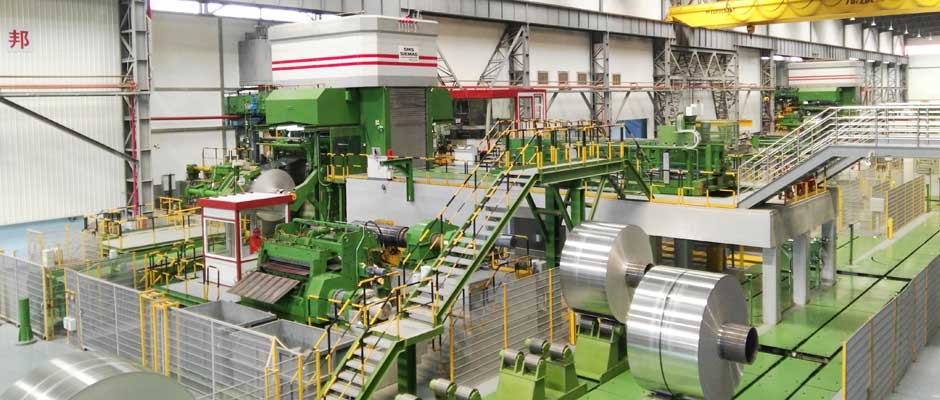
The rolling process directly determines the precision and performance of the thin sheet. Through multi-pass rolling on a six-roll cold rolling mill, combined with intermediate annealing, we control the sheet thickness tolerance within ±0.02mm, meeting the stringent flatness requirements of high-end building curtain walls. Regarding alloy temper control, the H36/H46 temper is suitable for roofing systems, with a yield strength ≥190MPa, balancing strength and formability; while the H34 temper is more suitable for the transportation sector, with elongation exceeding 5%, adapting to complex molding requirements.
Surface treatment is key to extending material lifespan and adapting to different application scenarios. For export projects in coastal areas, we use PVDF fluorocarbon coating technology, employing a two-coat two-bake or three-coat three-bake roller coating technique to achieve a coating thickness ≥25μm. After 4000 hours of salt spray testing, the corrosion area is ≤1 level, and after 4000 hours of xenon lamp aging testing, the color difference ΔE is ≤4.0, ensuring weather resistance for over 30 years. For industrial customers, anodizing treatment forms a 15-25μm porous oxide film with a density exceeding 95%, and the chloride ion permeability coefficient is reduced by 6 orders of magnitude compared to the substrate, perfectly adapting to highly corrosive environments.
Core Advantages: Versatile Characteristics Adaptable to Diverse Scenarios
Based on Haomei Aluminum’s years of export experience, the widespread application of al-mg-mn alloy sheets stems from their comprehensive advantages of being lightweight, strong, durable, aesthetically pleasing, and environmentally friendly, precisely matching the core needs of customers in various industries.
The lightweight and high-strength characteristics significantly reduce the structural load on buildings, enabling large-span roof designs while reducing transportation and construction costs—for projects exported to regions with high logistics costs such as Africa and South America, transportation costs can be reduced by more than 20% per square meter of sheet. Its excellent shaping capabilities can accommodate complex designs such as curves and surfaces.
Under the trend of environmental protection, the green attributes of materials are becoming increasingly important. Aluminum-magnesium-manganese alloy has a recycling rate of over 95%, with recycled materials accounting for up to 80%. Its total life-cycle carbon footprint is only 25 kg CO₂/m², meeting LEED green building certification standards and helping European and American customers obtain green building credits. Meanwhile, the material boasts a Class A fire resistance rating, exhibits no heavy metal leaching, and meets the safety requirements of public buildings such as schools and hospitals.
Furthermore, its excellent thermal conductivity (120-160 W/(m·K)) and electromagnetic shielding performance (electromagnetic wave absorption rate >90%) have expanded its applications in electronic equipment, energy storage containers, and other fields. Haomei’s customized energy storage panels for CATL, after special anti-corrosion treatment, have seen a three-fold increase in acid rain resistance and have already been applied in batches to overseas photovoltaic power plant projects.
Combining the climatic characteristics and project requirements of different regions globally, the Haomei Aluminum technical team has summarized targeted selection solutions to help customers maximize cost-effectiveness.
For building roofing projects, AA3004 grade H36 temper al-mg-mn sheets are preferentially recommended, with a thickness of 0.9-1.2mm, combined with a PVDF coating, suitable for various scenarios from temperate continental climates to tropical maritime climates; in coastal areas, an additional coating thickness of 30μm is required to enhance salt spray resistance. For industrial plant projects, the AA3003 grade product with anodized finish is a better choice, offering lower costs and meeting corrosion resistance requirements.
As an aluminum processing company deeply rooted in the export market, Haomei Aluminum believes that the value of al-mg-mn alloy sheets lies not only in the material itself, but also in providing global customers with high-quality, efficient, and environmentally friendly solutions through precise composition control, process optimization, and scenario adaptation. From fine-tuning the composition before the smelting furnace to the precision control in the coating workshop, this dedication to every detail is a response to customer trust and the core strength that allows us to stand firm in the global aluminum processing market.